


How Can You Tell If You Have Prostatitis?
Many men who begin experiencing urinary discomfort or pelvic pain ask a very specific question: how can you tell if you have prostatitis?
The answer is not always straightforward. Prostatitis is one of the most common urological conditions, but it is also one of the most difficult to recognize. Its symptoms can vary widely and are often confused with those of other diseases involving the prostate, bladder, intestines, or even the spine.
In some cases, symptoms appear suddenly and dramatically, with high fever and difficulty urinating. In others, however, the condition develops gradually with mild symptoms that may persist for months or even years.
Recognizing the early signs of prostatitis can help patients obtain a diagnosis sooner and avoid unnecessary treatments.
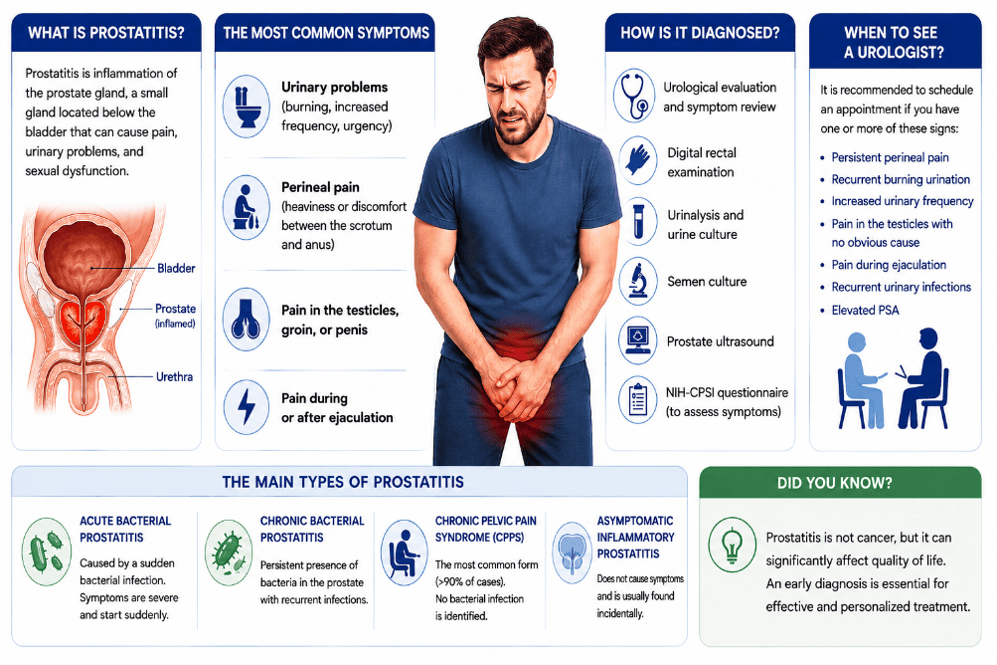
What Is Prostatitis?
Prostatitis is an inflammation of the prostate gland, a male reproductive organ located below the bladder and surrounding the urethra. The prostate produces an important portion of seminal fluid and plays a significant role in male fertility and sexual function.
According to the National Institutes of Health (NIH), prostatitis is classified into four distinct categories. Acute bacterial prostatitis is a sudden infection caused by bacteria, characterized by severe symptoms that require immediate treatment. Chronic bacterial prostatitis, on the other hand, involves a persistent bacterial infection within the prostate and recurrent urinary tract infections. The most prevalent type, accounting for more than 90% of prostatitis cases, is chronic pelvic pain syndrome (CPPS), where in many patients no bacterial infection can be identified. Finally, asymptomatic inflammatory prostatitis causes no symptoms at all and is usually discovered incidentally during tests performed for other reasons.
What Are the First Symptoms of Prostatitis?
The initial symptoms can vary considerably from one patient to another. Some men experience primarily pain, while others develop urinary issues or sexual symptoms.
The most common manifestations include a burning sensation during urination and increased urinary frequency, often accompanied by perineal or testicular pain. Patients frequently report widespread pelvic discomfort, pain during ejaculation, a feeling of heaviness between the anus and genitals, or difficulty completely emptying the bladder. Many patients describe a vague feeling of discomfort that is difficult to localize precisely.
Perineal Pain Is an Important Warning Sign
One of the most characteristic symptoms of chronic prostatitis is perineal pain, located in the area between the scrotum and the anus. Patients may describe feeling pressure, heaviness, tightness, or a persistent sensation of a foreign body, along with noticeable pain when sitting for prolonged periods. In some cases, the discomfort is constant, while in others it appears only under specific circumstances, such as after ejaculation or after many hours of sitting at a desk.
Urinary Symptoms May Suggest Prostatitis
Because the prostate surrounds the urethra, inflammation can cause urinary symptoms that closely resemble those seen in urinary tract infections or benign prostatic enlargement.
Burning urination is highly common and may occur at the beginning, throughout, or at the end of urination. Many patients report intermittent burning that tends to worsen during periods of high stress. This is often accompanied by increased urinary frequency, where patients feel the need to urinate much more often than normal even when only a small amount of urine is present in the bladder, as well as urinary urgency, which presents as a sudden and difficult-to-control urge to urinate. Furthermore, after urinating, patients often experience a sensation of incomplete emptying, feeling that some urine still remains inside the bladder.
Can Prostatitis Cause Testicular Pain?
Yes, absolutely. Many men visit a urologist because of persistent testicular pain that is initially thought to originate in the testicles themselves. In reality, the pain may arise from the inflamed prostate and the interconnected nerves of the pelvic floor. The discomfort may involve one testicle or both, and can radiate to the groin or follow the spermatic cord. In these situations, scrotal ultrasound findings are almost always completely normal.
Sexual Symptoms of Prostatitis
Since the prostate is closely linked to male sexual function, prostatitis may affect several aspects of a man’s sexual health.
One of the most suggestive symptoms is pain during or after ejaculation, which may occur at the peak of orgasm, immediately afterward, or present as an ache several hours later. Chronic inflammation, persistent pain, and the psychological stress associated with the condition may also negatively affect erectile function, leading to reduced erectile quality. Additionally, several studies have shown a higher prevalence of premature ejaculation among men suffering from chronic prostatitis. Ultimately, dealing with chronic pain can significantly affect overall quality of life and lead to a noticeable reduction in sexual desire.
When Should Acute Bacterial Prostatitis Be Suspected?
Acute bacterial prostatitis behaves very differently from chronic forms of the condition. Typical symptoms present suddenly and include high fever accompanied by chills, severe perineal pain, and significant difficulty urinating. Patients also commonly experience general malaise and widespread muscle aches. Anyone experiencing this sudden onset of severe symptoms should seek medical attention promptly.
How Is Prostatitis Diagnosed?
Symptoms alone are never sufficient for a definitive diagnosis. A urologist must carefully evaluate the clinical picture through a combination of targeted examinations.
A detailed medical history and symptom assessment during a urological evaluation are the essential first steps. This is typically followed by a digital rectal examination, which allows the specialist to evaluate the prostate’s size, consistency, and tenderness; a particularly tender prostate is a strong indicator of prostatitis. Urinalysis helps exclude simple urinary tract infections and identify potential bacterial causes, while a urine culture is especially useful when a bacterial origin is suspected. A semen culture may also be indicated in selected patients with persistent symptoms. To complete the clinical picture, a prostate ultrasound may be performed to assess prostate volume, check for calcifications, and measure post-void residual urine. Finally, urologists often use the validated NIH-CPSI questionnaire to objectively measure symptom severity and its true impact on the patient’s quality of life.
Can Prostatitis Increase PSA Levels?
Yes, prostatic inflammation may cause a temporary elevation in PSA (Prostate-Specific Antigen) levels in the blood. However, an elevated PSA does not automatically indicate prostatitis.
Other conditions may also increase PSA levels, including prostate cancer, benign prostatic hyperplasia, urinary tract infections, recent ejaculation, intense physical activity, or recent prostate manipulation. Because of this, PSA results should always be carefully interpreted by a specialist within the broader clinical context.
What Conditions Can Be Mistaken for Prostatitis?
One reason prostatitis is difficult to diagnose is that many other disorders can produce strikingly similar symptoms. These clinical mimics include urinary tract infections, benign prostatic hyperplasia, urinary stones, interstitial cystitis, and overactive bladder syndrome. Sometimes the root cause lies in pelvic floor dysfunction, pudendal nerve disorders, intestinal diseases, or even inguinal hernias. For all these reasons, a proper specialist evaluation is essential to avoid misdiagnosis.
When Should You See a Urologist?
As a general rule, a urological consultation is highly recommended if symptoms persist for more than a few weeks or begin to significantly affect your daily quality of life. You should definitely consider seeing a urologist if you experience persistent perineal pain, unexplained testicular pain, recurrent burning during urination, or painful ejaculation. Likewise, an increased urinary frequency, an unexplained elevated PSA, or recurrent urinary tract infections warrant prompt medical attention.
FAQ – Frequently Asked Questions About Prostatitis
How do I know if I have prostatitis?
Perineal pain, burning urination, increased urinary frequency, testicular pain, or painful ejaculation may suggest prostatitis. However, a definitive diagnosis requires a proper evaluation by a urologist.
Can prostatitis be diagnosed with a blood test?
There is no specific blood test that can magically diagnose prostatitis. PSA levels may sometimes be elevated due to inflammation, but PSA is not a primary diagnostic test for this condition.
Can prostatitis occur without infection?
Yes. In fact, the vast majority of patients suffer from chronic prostatitis or chronic pelvic pain syndrome without any detectable bacterial infection.
Can prostatitis cause anal pain?
Yes. Prostatitis may cause pain, pressure, or discomfort in the anal and perianal region because of the incredibly close anatomical and neurological relationship between the prostate and the pelvic floor.
Can prostatitis cause erectile dysfunction?
Yes. The combination of chronic inflammation, constant pain, and psychological stress may easily contribute to erectile difficulties.
Can prostatitis cause infertility?
In some cases, yes. Chronic inflammation may eventually affect semen quality and potentially influence male fertility.
Can prostatitis last for years?
Yes. Chronic forms often have a fluctuating course with periods of noticeable improvement followed by sudden symptom flare-ups.
Can prostatitis be mistaken for prostate cancer?
While some symptoms may overlap, they are entirely different medical conditions. A specialist evaluation can easily distinguish between them.
What is the most typical symptom of prostatitis?
Perineal pain or a feeling of heavy discomfort is one of the most characteristic hallmark symptoms, particularly in chronic prostatitis.
Can prostatitis be cured?
Many patients achieve significant improvement through an accurate diagnosis and a highly individualized treatment plan. The overall prognosis depends heavily on the type of prostatitis and its underlying causes.
Conclusion
Determining whether you have prostatitis is not always an easy task. Symptoms can vary greatly and may include perineal pain, burning urination, increased urinary frequency, testicular pain, and sexual dysfunction. The presence of one or more of these symptoms does not necessarily mean you have prostatitis, but it is a valid and important reason to seek a specialist evaluation.
Early diagnosis helps identify the true cause of the symptoms and allows the most appropriate treatment strategy to be implemented right away, preventing months or even years of unnecessary pain and discomfort.
References
- Krieger JN, Nyberg L Jr, Nickel JC. NIH consensus definition and classification of prostatitis. JAMA. 1999;282(3):236–237. https://pubmed.ncbi.nlm.nih.gov/10422990/
- Pontari MA, Ruggieri MR. Mechanisms in prostatitis/chronic pelvic pain syndrome. J Urol. 2004;172(3):839–845. https://pubmed.ncbi.nlm.nih.gov/18405756/
- Schaeffer AJ. Clinical practice. Chronic prostatitis and the chronic pelvic pain syndrome. N Engl J Med. 2006;355(16):1690–1698. https://www.ovid.com/10.1056/NEJMcp060423
- Nickel JC, Shoskes D, Wang Y, Alexander RB, Fowler JE Jr, Zeitlin S, et al. How does the pre-massage and post-massage test compare to the Meares-Stamey test in men with chronic prostatitis/chronic pelvic pain syndrome? J Urol. 2006;176(1):119–124. https://doi.org/10.1016/S0022-5347(06)00519-0
- Magri V, Wagenlehner FME, Perletti G. Contemporary management of chronic prostatitis/chronic pelvic pain syndrome. Eur Urol Focus. 2019;5(1):29–33. https://pubmed.ncbi.nlm.nih.gov/16753385/
- Franco JV, Turk T, Jung JH, Xiao YT, Iakhno S, Garrote V, Vietto V. Non-pharmacological interventions for treating chronic prostatitis/chronic pelvic pain syndrome. Cochrane Database Syst Rev. 2018;5(5). https://pubmed.ncbi.nlm.nih.gov/29757454/
- Engeler D, Baranowski AP, Borovicka J, Cottrell AM, Dinis-Oliveira P, Elneil S, et al. EAU Guidelines on Chronic Pelvic Pain. European Association of Urology (EAU Guidelines). Arnhem, The Netherlands; updated annually. https://share.google/bviFVZkGEJcRQpKZf
- Shoskes DA, Nickel JC, Rackley RR, Pontari MA. Clinical phenotyping in chronic prostatitis/chronic pelvic pain syndrome and interstitial cystitis: a management strategy for urologic chronic pelvic pain syndromes. Prostate Cancer Prostatic Dis. 2009;12(2):177–183. https://pubmed.ncbi.nlm.nih.gov/18645581/
