


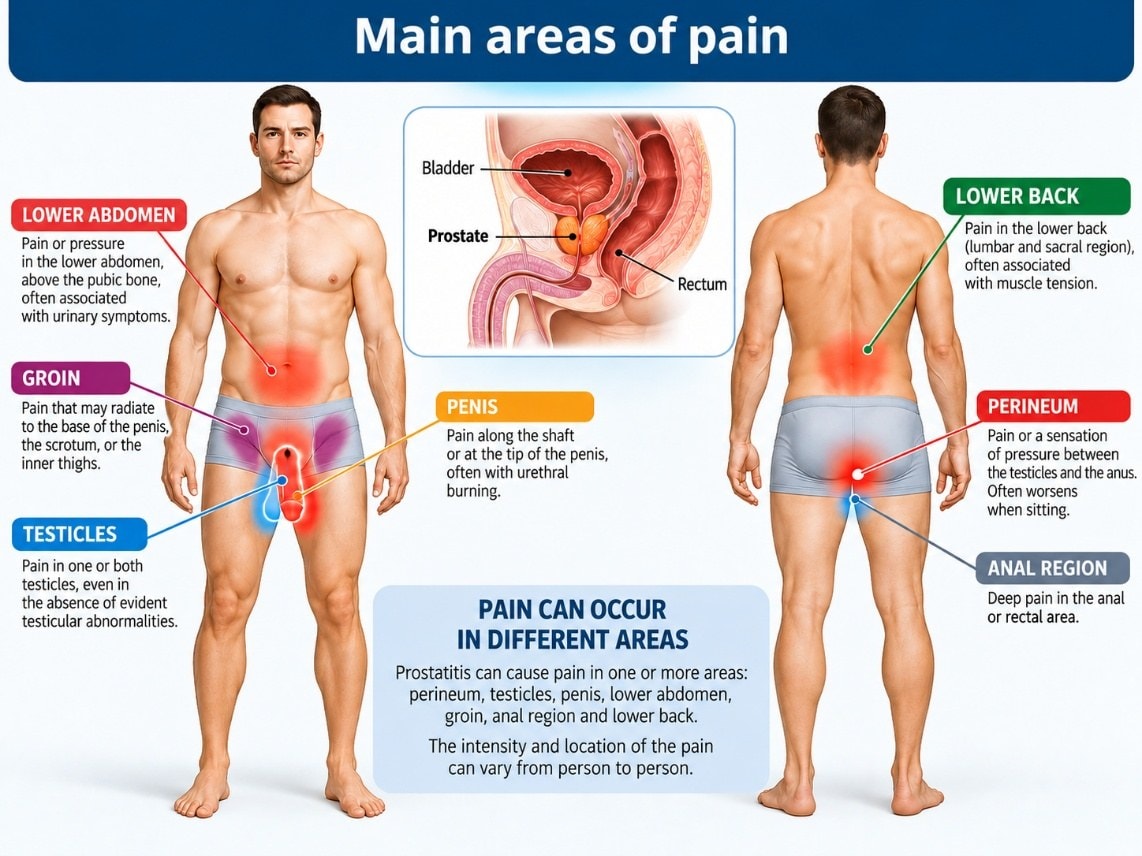
Prostatitis can cause pain in several areas: the perineum (between the testicles and the anus), testicles, penis, lower abdomen, groin, and lumbosacral region. The pain may be constant or intermittent and may worsen during urination, ejaculation, or prolonged sitting. However, these symptoms do not necessarily indicate a prostate infection and may also be associated with chronic pelvic pain syndrome.
Pain Locations, Associated Symptoms, Causes, and How to Recognize Prostatic Pain
Prostatitis is one of the urological conditions that can cause pain in different parts of the body, often even in areas far from the prostate. Many men wonder: where does prostatitis cause pain? Is the pain felt only in the prostate area, or can it also affect the testicles, penis, groin, and back?
The answer is that pain associated with prostatitis can occur in numerous locations, with characteristics and intensity varying considerably from one patient to another.
Some men report persistent discomfort in the perineal region, while others experience testicular pain, urethral burning, or a sensation of pressure in the lower abdomen.
In chronic cases, the pain may persist for months, alternating between periods of improvement and flare-ups.
However, it is important to distinguish bacterial prostatitis from chronic pelvic pain syndrome (CP/CPPS), because not all pain attributed to the prostate is caused by an infection. Understanding where the pain occurs, its characteristics, and the symptoms that accompany it is the first step toward an accurate diagnosis.
Key Takeaways
- Prostatitis and chronic pelvic pain syndrome (CP/CPPS) produce pain in multiple pelvic areas beyond the prostate itself: perineum, testicles, penile shaft and tip, lower abdomen, groin, and lower back.
- The most characteristic presentation is perineal pain, commonly described by patients as the uncomfortable feeling of «sitting on a golf ball», worsening substantially during prolonged sitting or cycling.
- Testicular and groin discomfort is frequently referred pain caused by pelvic nerve convergence (pudendal nerve) and pelvic floor muscle spasms, even when testicles are completely healthy.
- Not all pelvic pain is bacterial: the vast majority of chronic cases belong to CP/CPPS and require a multimodal approach (local TECAR therapy, pelvic floor physical therapy, muscle relaxants) rather than repeated unnecessary antibiotic rounds.
- Warning signs such as high fever with chills, acute urinary retention, visible hematuria (blood in urine), or sudden severe testicular pain require immediate medical evaluation.
Table of Contents
- 1. Where Is the Prostate Located and Why Can It Cause Pain?
- 2. Perineal Pain: The Most Characteristic Symptom
- 3. Can Prostatitis Cause Testicular Pain?
- 4. Pain in the Penis and at the Tip of the Penis
- 5. Pain in the Lower Abdomen and Above the Pubic Bone
- 6. Can Prostatitis Cause Groin Pain?
- 7. Back Pain and Pain in the Lumbosacral Region
- 8. Pain During and After Ejaculation
- 9. Does Prostatitis Pain Get Worse During Urination?
- 10. How Does Pain Differ Between the Various Types of Prostatitis?
- 11. Why Can Prostatitis Pain Move From One Area to Another?
- 12. How Can You Tell Whether the Pain Really Comes From the Prostate?
- 13. How Long Can Prostatitis Pain Last?
- 14. How Is Pain Associated With Prostatitis Treated?
- 15. When Does Pain Require Urgent Medical Attention?
- 16. Frequently Asked Questions: Where Does Prostatitis Cause Pain?
- 17. Conclusion
- Bibliography & Scientific References
1. Where Is the Prostate Located and Why Can It Cause Pain?
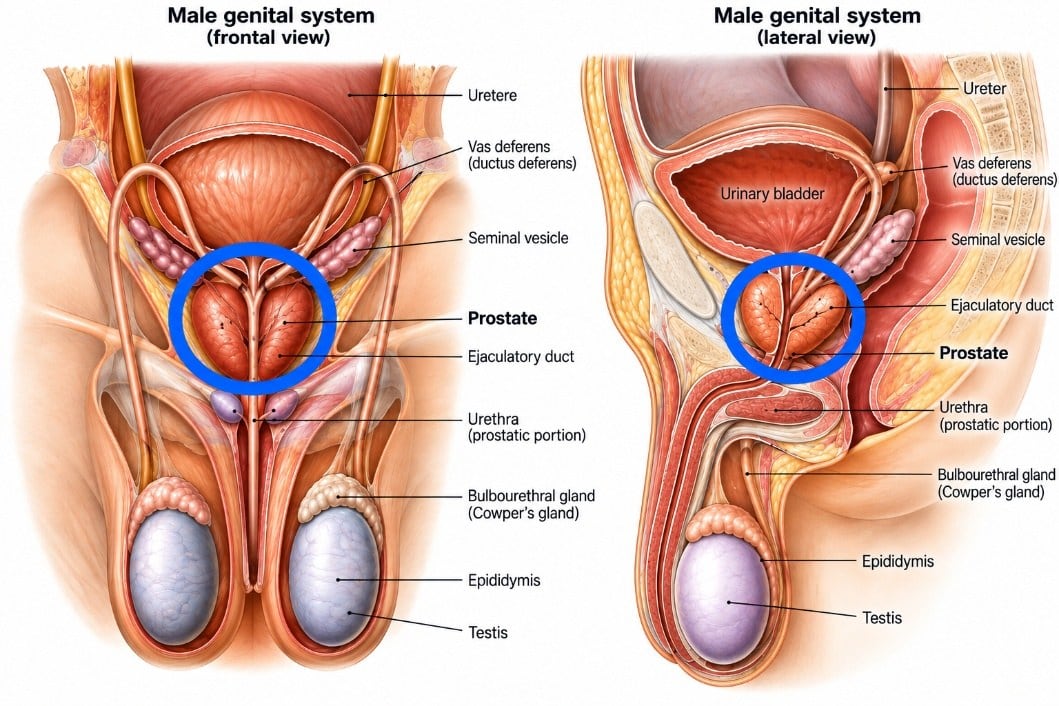
The prostate is a gland of the male reproductive system, located immediately below the bladder and in front of the rectum. The first part of the urethra, the tube that carries urine from the bladder to the outside of the body, passes through the prostate.
The prostate gland is surrounded by muscular, nervous, and vascular structures involved in urinary and sexual functions. This particular anatomical location explains why an inflammatory process affecting the prostate, or a chronic pelvic pain condition, can produce symptoms in different areas.
Pain is not necessarily perceived exactly where the prostate is located. In fact, the nerve pathways that transmit pain signals from the prostate share spinal circuits with those of other organs and structures within the pelvis.
This phenomenon, known as referred pain, can cause pain to be perceived in areas other than its actual source. In chronic pelvic pain syndromes, pelvic floor muscle tension, increased sensitivity of nerve pathways, and central sensitization mechanisms may also contribute to the development and persistence of pain.
2. Perineal Pain: The Most Characteristic Symptom
The perineum is the anatomical region between the scrotum and the anus.
It is one of the most characteristic locations of pain associated with prostatitis and chronic pelvic pain syndrome. Patients may describe their symptoms as:
- A sensation of heaviness or pressure between the testicles and the anus.
- Deep, constant, or intermittent pain.
- A burning sensation in the perineal region.
- A feeling of having a foreign body in the perineum.
- Discomfort that worsens when sitting.
Some patients use a particularly descriptive expression: “It feels as though I’m sitting on a golf ball.”
This sensation may become especially uncomfortable during long car journeys, when working in a seated position for several hours, or during activities that place pressure on the perineum, such as cycling.
However, perineal pain is not exclusive to prostatitis. It may also occur in pelvic floor dysfunction and certain neuropathic conditions, including pudendal neuralgia.
3. Can Prostatitis Cause Testicular Pain?
Yes. Testicular pain may occur in patients with prostatitis, particularly in chronic forms.
In these cases, patients may experience a dull ache in one or both testicles, even in the absence of obvious testicular abnormalities. The discomfort may radiate to the scrotum, groin, or perineal region.
This phenomenon can be explained by the convergence of nerve pathways transmitting pain signals from different structures of the male reproductive system.
It is important to emphasize that testicular pain does not necessarily mean that the testicle itself is inflamed. A patient may have normal testicles on physical examination and ultrasound while still experiencing persistent scrotal pain.
However, before attributing the pain to the prostate, other possible causes must be excluded, including epididymitis, orchitis, inguinal hernia, and local testicular disorders. Sudden, severe testicular pain requires urgent medical evaluation to rule out testicular torsion.
4. Pain in the Penis and at the Tip of the Penis
Another relatively common location of chronic pelvic pain is the penis.
Pain may occur along the penile shaft, in the glans, or particularly around the urethral opening. Some patients report a burning sensation at the tip of the penis, even when they are not urinating.
Others describe a stinging sensation, irritation, or deep pain inside the urethra. These symptoms may be associated with prostatitis, but they can also occur with urethritis, sexually transmitted infections, or altered nerve sensitivity. In chronic conditions, penile pain may be intermittent and occur without any apparent cause.
Sometimes it develops after ejaculation or becomes more intense during periods of stress and muscular tension.
Pain at the tip of the penis, especially when microbiological tests are negative, therefore requires an assessment that goes beyond simply looking for bacteria in the prostate.
5. Pain in the Lower Abdomen and Above the Pubic Bone
Prostatitis may be associated with pain in the suprapubic region, meaning the lower part of the abdomen immediately above the pubic bone.
Patients may describe a sensation of pressure over the bladder, persistent discomfort, or pain that increases as the bladder fills. In some cases, the pain is accompanied by increased urinary frequency, urinary urgency, or a sensation of incomplete bladder emptying.
These symptoms may occur in bacterial prostatitis as well as in chronic pelvic pain syndromes. However, other possible causes should be considered, particularly when pain increases with bladder filling and decreases after urination.
In these circumstances, it may also be necessary to investigate bladder pain syndrome. Therefore, suprapubic pain alone cannot reliably identify the prostate as the source of the pain.
6. Can Prostatitis Cause Groin Pain?
Groin pain is a symptom that may accompany certain forms of chronic pelvic pain. It may affect one or both sides and sometimes radiate toward the base of the penis, the scrotum, or the inner thighs.
The pain may be perceived as muscular tension, a pulling sensation, or deep discomfort. In chronic pelvic pain syndromes, muscular factors may play an important role. Persistent contraction of the pelvic floor muscles and surrounding muscular structures may contribute to both the development and persistence of pain.
However, groin pain may also result from hernias, hip disorders, muscular problems, or peripheral neuropathies. For this reason, diagnosis requires a careful clinical evaluation.
7. Back Pain and Pain in the Lumbosacral Region
Many patients with chronic prostatitis also report lower back pain. The discomfort mainly affects the lumbosacral region and may be associated with muscular stiffness or pain around the sacrum. However, back pain is extremely common in the general population and is not a specific symptom of prostatitis.
When lower back pain is accompanied by high fever, chills, and urinary symptoms, an upper urinary tract infection, such as pyelonephritis, must also be considered.
In chronic conditions, lumbosacral pain may instead be related to muscular tension, postural abnormalities, or referred pain mechanisms. It is therefore important not to automatically attribute every episode of lower back pain to the prostate.
8. Pain During and After Ejaculation
One symptom that may suggest a prostatic disorder or chronic pelvic pain syndrome is pain associated with ejaculation. Patients may experience pain during orgasm or immediately afterward. The pain may involve the perineum, suprapubic region, penis, or testicles. In some cases, the discomfort lasts only a few minutes; in others, it may persist for several hours.
During ejaculation, coordinated contractions occur in the pelvic muscles and the organs involved in the emission of seminal fluid. When inflammatory conditions, muscular dysfunction, or nerve hypersensitivity are present, these contractions may become painful.
Pain after ejaculation is an important symptom, but it is not sufficient on its own to diagnose prostatitis. Other conditions, including pelvic floor dysfunction and certain disorders of the seminal tract, must also be considered.
9. Does Prostatitis Pain Get Worse During Urination?
In some patients, prostatitis may cause pain or burning during urination. This symptom is known as dysuria. The burning sensation may be felt along the urethra, at the tip of the penis, or in the perineal region.
In acute bacterial prostatitis, it may be accompanied by fever, chills, increased urinary frequency, urinary urgency, and difficulty urinating. In chronic conditions, however, pain during urination may be intermittent and occur despite negative urine tests.
It is essential to distinguish between these situations because urinary burning may also be caused by cystitis, urethritis, urinary stones, or other conditions. High fever accompanied by significant difficulty urinating requires prompt medical evaluation.
10. How Does Pain Differ Between the Various Types of Prostatitis?
Not all forms of prostatitis cause the same type of pain.
Clinical manifestations depend on the underlying condition responsible for the symptoms.
| Clinical Condition | Pain Characteristics |
|---|---|
| Acute bacterial prostatitis | Pelvic or perineal pain of sudden and severe onset, often accompanied by high fever, chills, and marked urinary symptoms. |
| Chronic bacterial prostatitis | Variable, recurrent, or intermittent pain, with documented episodes of recurrent urinary tract infections. |
| Chronic pelvic pain syndrome (CP/CPPS) | Persistent or recurrent pain in one or more pelvic regions for at least three months, without demonstrable bacterial infection. |
| Asymptomatic inflammatory prostatitis | Absence of pain or subjective symptoms referable to the prostate (incidental finding during other urological evaluations). |
This distinction is also essential when selecting the appropriate treatment.
Documented bacterial prostatitis requires a different therapeutic approach from chronic pelvic pain syndrome without evidence of infection.
11. Why Can Prostatitis Pain Move From One Area to Another?
One particularly frustrating feature for some patients is the changing location of the pain. One day, the discomfort may be located in the perineum; the following day, in the testicles; and later, at the tip of the penis. This variability does not necessarily mean that inflammation is spreading.
Several mechanisms may be involved in chronic pelvic pain syndromes. Referred pain may cause a painful stimulus to be perceived in an area different from its actual origin. Pelvic floor muscle contraction may contribute to persistent muscular tension and produce pain in several locations.
Peripheral and central sensitization may increase the nervous system’s response to stimuli, making even normally harmless sensations painful. Finally, stress and anxiety may amplify pain perception and promote muscular tension, without implying that the pain is imaginary or exclusively psychological.
12. How Can You Tell Whether the Pain Really Comes From the Prostate?
The location of pain is only one of the elements needed to establish a diagnosis. A urological evaluation should consider the duration of symptoms, pain characteristics, any associated urinary or sexual disorders, and the presence of documented episodes of infection.
The clinical examination may include assessment of the abdomen, external genitalia, perineal region, and a digital rectal examination. It is also important to evaluate the pelvic floor muscles, particularly in patients with persistent pain.
Depending on the clinical presentation, useful investigations may include:
- Validated questionnaires, such as the NIH-CPSI, to measure symptoms and their impact on quality of life.
- Urinalysis and urine culture.
- Transrectal prostate ultrasound.
- Uroflowmetry with post-void residual volume evaluation.
It is also important to remember that a normal prostate ultrasound does not exclude chronic pelvic pain syndrome. Similarly, the presence of prostatic calcifications does not automatically prove that they are responsible for the pain.
13. How Long Can Prostatitis Pain Last?
The duration of pain depends on the underlying condition. In acute bacterial prostatitis, symptoms may appear suddenly and improve with appropriate antibiotic treatment, although complete resolution may take time. In chronic bacterial prostatitis, recurrent episodes may occur, often associated with the persistence or recurrence of infection.
Chronic pelvic pain syndrome is generally defined by persistent or recurrent pelvic pain lasting at least three months, in the absence of other causes that fully explain the clinical presentation. In some patients, symptoms may persist for very long periods, alternating between phases of remission and flare-ups.
The duration of pain does not necessarily indicate the presence of a persistent infection. This is one reason why repeated courses of antibiotics, without microbiological evidence of infection, may prove ineffective.
14. How Is Pain Associated With Prostatitis Treated?
First of all, there is no single treatment that is effective for every patient. The primary goal is to identify the factors contributing to the pain and address each of them. Treatment must be personalized according to the diagnosis and the mechanisms responsible for the symptoms.
When bacterial prostatitis is documented, antibiotic therapy should be selected according to the identified microorganism, its antibiotic susceptibility, and the patient’s clinical characteristics.
In chronic pelvic pain syndromes, however, a multimodal approach is necessary. Treatment options may include muscle relaxants, pain-relieving medications, alpha-blockers, specialized pelvic floor physiotherapy, TECAR therapy, and treatments targeting neuropathic pain components.
Specifically, in patients with increased pelvic floor muscle tone, medication may be combined with relaxation techniques and manual physiotherapy, while avoiding indiscriminate strengthening exercises that could worsen symptoms. In our clinical experience, local treatments using TECAR therapy have been particularly effective.
Lifestyle modifications may also be helpful, such as reducing prolonged sitting, limiting activities that aggravate pain, and improving stress management.
15. When Does Pain Require Urgent Medical Attention?
Not all pelvic pain is caused by prostatitis, and some conditions require immediate medical evaluation. In particular, prompt medical attention is necessary in the presence of high fever and chills, inability to urinate, significant deterioration in general health, or sudden and severe testicular pain.
The appearance of visible blood in the urine also requires appropriate investigation and should not automatically be attributed to prostatitis. In patients with acute bacterial prostatitis, fever and signs of systemic illness may indicate a potentially serious infection. In these cases, it is not advisable to wait for symptoms to resolve spontaneously.
16. Frequently Asked Questions: Where Does Prostatitis Cause Pain?
Can prostatitis cause testicular pain?
Yes. Pain may be referred to the testicles even when no obvious abnormalities are present. However, specific testicular disorders must still be ruled out.
Can prostatitis cause pain at the tip of the penis?
Yes. Pain or burning at the tip of the penis may occur in chronic pelvic pain syndromes, but also in other conditions, such as urethritis and neuropathies.
Can prostatitis cause back pain?
It may be associated with lumbosacral pain, particularly in chronic conditions. However, isolated back pain is not a specific sign of prostatitis.
Why does prostatitis hurt more when I am sitting?
Sitting may increase pressure on the perineum and aggravate pain in the presence of local hypersensitivity, muscular tension, or neuropathic disorders.
Is it normal to experience pain after ejaculation?
Pain after ejaculation may occur in prostatitis and chronic pelvic pain syndromes. However, it should not be considered normal when it is persistent or recurrent.
Can you have prostate pain without bacteria?
Yes. This is common in chronic pelvic pain syndrome, in which pain may result from several different mechanisms even in the absence of a demonstrable bacterial infection.
Can prostatitis cause anal pain?
Yes. Some patients, particularly those with associated pudendal nerve inflammation, experience deep pain in the rectal or perianal region. In these cases, anorectal disorders and muscular dysfunction must also be excluded.
17. Conclusion
Where does prostatitis cause pain? The most characteristic locations are the perineum, suprapubic region, testicles, penis, and, in some cases, the groin and lumbosacral region.
Pain may be constant or intermittent, localized or widespread, and may worsen during urination, ejaculation, or prolonged sitting.
It is essential to understand that the distribution of pain alone is not sufficient to diagnose prostatitis. In particular, in chronic pelvic pain syndromes, pain may result from muscular, neurological, and sensitization mechanisms, even in the absence of a bacterial infection.
An accurate diagnosis is therefore essential to avoid unnecessary treatments, especially repeated antibiotic courses without a documented indication.
When pelvic pain persists or frequently recurs, a thorough urological evaluation can help identify possible causes and establish a personalized treatment plan.
Bibliography & Scientific References
- Lai HH, Pontari MA, Argoff CE, et al. Male Chronic Pelvic Pain: AUA Guideline: Part I Evaluation and Management Approach. J Urol. 2025;214(2):116–126. [DOI: 10.1097/JU.0000000000004564]
- Lai HH, Pontari MA, Argoff CE, et al. Male Chronic Pelvic Pain: AUA Guideline: Part II Treatment of Chronic Prostatitis/Chronic Pelvic Pain Syndrome. J Urol. 2025;214(2):127–137. [DOI: 10.1097/JU.0000000000004565]
- European Association of Urology (EAU). EAU Guidelines on Chronic Pelvic Pain. 2025 Edition. EAU Guidelines Office, Arnhem, The Netherlands. [EAU Guidelines 2025]
- Krieger JN, Nyberg L Jr, Nickel JC. NIH consensus definition and classification of prostatitis. JAMA. 1999;282(3):236–237. [DOI: 10.1001/jama.282.3.236]
- Litwin MS, McNaughton-Collins M, Fowler FJ Jr, et al. The National Institutes of Health chronic prostatitis symptom index: development and validation of a new outcome measure. J Urol. 1999;162(2):369–375. [DOI: 10.1016/S0022-5347(05)68562-X]
- Rees J, Abrahams M, Doble A, Cooper A. Diagnosis and treatment of chronic bacterial prostatitis and chronic prostatitis/chronic pelvic pain syndrome: a consensus guideline. BJU Int. 2015;116(4):509–525. [DOI: 10.1111/bju.13101]
- Shoskes DA, Nickel JC, Dolinga R, Prots D. Clinical phenotyping of patients with chronic prostatitis/chronic pelvic pain syndrome and correlation with symptom severity. Urology. 2009;73(3):538–542. [DOI: 10.1016/j.urology.2008.09.074]
- Anderson RU, Wise D, Sawyer T, Chan C. Integration of myofascial trigger point release and paradoxical relaxation training treatment of chronic pelvic pain in men. J Urol. 2005;174(1):155–160. [DOI: 10.1097/01.ju.0000161609.31185.d5]
- Propert KJ, McNaughton-Collins M, Leiby BE, et al. A prospective study of symptoms and quality of life in men with chronic prostatitis/chronic pelvic pain syndrome: the National Institutes of Health Chronic Prostatitis Cohort study. J Urol. 2006;175(2):619–623. [DOI: 10.1016/S0022-5347(05)00233-8]
- Pontari MA, Giusto LL. New developments in the diagnosis and treatment of chronic prostatitis/chronic pelvic pain syndrome. Curr Opin Urol. 2013;23(6):565–569. [DOI: 10.1097/MOU.0b013e3283656a55]
