



Suddenly seeing blood in the urine can understandably be a cause for concern.
The presence of blood in the urine is known as hematuria.
In most cases, hematuria does not automatically mean that you have cancer. There are many possible causes, including urinary tract infections, urinary stones, prostate conditions, trauma, strenuous physical exercise, and other benign conditions.
However, there is one fundamental principle: an episode of visible blood in the urine, especially when it occurs without pain and without an obvious cause, should never be ignored, because it may be the first sign of bladder cancer or, less frequently, other cancers of the urinary tract.
Let us therefore look at when blood in the urine should be a cause for concern and which diagnostic tests may be necessary.
Key Takeaways
- The presence of blood in the urine (hematuria) is a frequent clinical sign that, in most cases, is caused by benign conditions such as urinary tract infections, kidney stones, prostate enlargement, or physical exertion.
- An episode of visible (gross) hematuria, especially when painless and occurring without burning, should never be ignored, as it can be the primary early sign of bladder cancer.
- The spontaneous disappearance of visible blood does not mean the problem is resolved: bleeding from a bladder tumor is typically intermittent and may pause for weeks or months.
- Core diagnostic investigations include urinalysis, urine culture, urinary tract ultrasound, and flexible cystoscopy to pinpoint the exact source of bleeding.
- Individual risk factors (age over 45–50 years, tobacco smoking, occupational chemical exposures) warrant an immediate and thorough urological evaluation.
Table of Contents
- Hematuria can be divided into two types
- Does blood in the urine always mean cancer?
- What are the most common causes of blood in the urine?
- When Can Blood in the Urine Indicate Bladder Cancer?
- Which People Are at Greater Risk?
- Is Painful Hematuria Less Concerning?
- What If the Blood Is Microscopic?
- Which Tests Are Performed When Blood Appears in the Urine?
- What If I Take Anticoagulants?
- When Should You See a Urologist Promptly?
- The Most Important Message: Do Not Wait for a Second Episode
- Conclusion
- Frequently Asked Questions (FAQ)
- Bibliography
Hematuria can be divided into two types
Visible hematuria
This is blood that the patient can see directly. The urine may range in color from pink to reddish-brown and, in more severe cases, may sometimes contain blood clots.
A large amount of blood is not necessary to change the color of the urine. Even relatively minor bleeding can produce a very noticeable change.
Microscopic hematuria (microhematuria)
In this case, the urine appears normally yellow, and the presence of blood is detected during a urine test. Microhematuria may be occasional or persistent.
According to clinical guidelines, microhematuria is defined as the presence, on microscopic examination, of at least 3 red blood cells per high-power field (≥3 RBC/HPF) in a properly collected urine specimen.
Therefore, a positive urine dipstick test for blood should be confirmed by microscopic examination.
Does blood in the urine always mean cancer?
Absolutely not. Hematuria is a clinical sign, not a diagnosis. It simply means that red blood cells may have entered the urine from somewhere along the urinary tract — the kidney, ureter, bladder, prostate, or urethra.
The urologist’s task is to determine where the blood is coming from and why the bleeding has occurred.
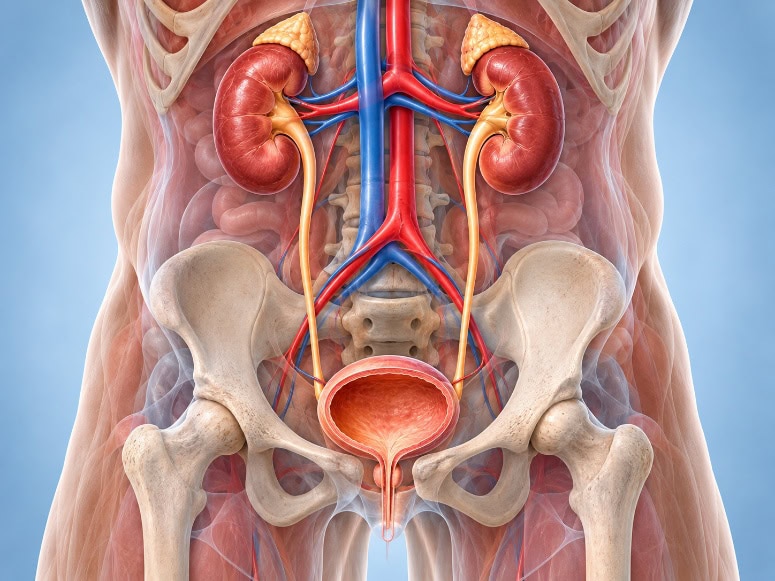
Many causes are benign and easily treatable. However, because tumors of the urinary tract are also among the possible causes, apparently unexplained hematuria requires appropriate evaluation.
What are the most common causes of blood in the urine?
Urinary tract infections

Cystitis and other urinary tract infections can cause hematuria. Statistically, this condition affects women far more frequently than men. In these cases, blood in the urine is usually associated with other symptoms, such as:
- burning during urination;
- frequent need to urinate;
- urinary urgency;
- suprapubic pain;
- cloudy or foul-smelling urine;
sometimes fever.
Urinalysis and urine culture can help identify the infection.
If the blood disappears completely after treatment of the infection, the cause may indeed have been infectious. However, if hematuria persists or recurs, further diagnostic evaluation is necessary.
Kidney and Ureteral Stones

Another common cause of hematuria is urinary stone disease. A stone moving within the kidney or ureter can irritate the lining of the urinary tract and cause bleeding.
The typical presentation is quite different from that of bladder cancer: in this case, blood in the urine may be associated with renal colic, characterized by severe pain in the flank that may radiate toward the groin or genitals.
However, this is not an absolute rule: some stones may cause hematuria with little pain or even without any pain.
Prostate Conditions
In men, the prostate can also be responsible for blood in the urine.
A significantly enlarged prostate due to benign prostatic hyperplasia (BPH) may become more vascularized and, in some cases, bleed.
Inflammation, prostate infections, or recent urological procedures can also cause temporary hematuria. However, the presence of BPH should not automatically lead to the assumption that every episode of hematuria originates from the prostate without considering other possible causes.
Strenuous Physical Activity
After particularly strenuous physical exercise, microscopic hematuria or, less commonly, visible hematuria may occasionally occur. This phenomenon is generally temporary.
However, if blood in the urine persists or recurs, especially in an adult with urological risk factors, it is advisable not to attribute it simply to physical exercise without further investigation.
Trauma and Urological Procedures
Trauma involving the kidneys or urinary tract can cause bleeding.
Some procedures may also temporarily cause blood in the urine, including:
- bladder catheterization;
- cystoscopy;
- biopsies;
- prostate surgery;
- bladder surgery;
procedures for urinary stones.
In these cases, hematuria is often expected and usually resolves progressively.
Warning: Red Urine Does Not Always Contain Blood
Red or pink urine does not necessarily mean hematuria.
Certain foods, pigments, or medications can change the color of the urine.
A classic example is beetroot, which can give the urine a reddish-purple color in some people.
If there is any doubt, a simple urinalysis can determine whether red blood cells are actually present.
When Can Blood in the Urine Indicate Bladder Cancer?
Bladder cancer is one of the most important conditions to rule out when hematuria occurs, particularly in certain groups of patients.
The classic presentation can be particularly deceptive:
Visible blood in the urine without pain.
The patient may feel perfectly well.
There is no fever.
There is no burning during urination.
There is no renal colic.
One day, the patient simply notices that the urine has turned red.
The bleeding may last only a few hours or one or two days and then disappear completely.
And it is precisely this disappearance of the bleeding that can be misleading.
“The blood has disappeared, so it must have been nothing.”

This is one of the most dangerous mistakes.
Bleeding caused by a bladder lesion can be intermittent.
This means that it may occur once, disappear spontaneously, and then recur weeks or months later. Therefore, the disappearance of hematuria does not automatically prove that the cause is benign. A single episode of unexplained gross hematuria may be sufficient to warrant a urological evaluation.
The NICE (National Institute for Health and Care Excellence) recommendations, updated in 2026, provide, for example, a pathway for suspected cancer in people aged 45 years or older with unexplained visible hematuria in the absence of a urinary tract infection, or when hematuria persists or recurs after successful treatment of a urinary tract infection.
Which People Are at Greater Risk?
The likelihood that hematuria has an underlying malignant cause is not the same for everyone.
The urologist takes several factors into consideration.
Age
The risk of urothelial cancer increases with age. An episode of hematuria in a young adult therefore has a very different statistical significance from the same episode in a person aged 65 or 75.
This does not mean that blood in the urine should be ignored in younger people, but rather that the diagnostic work-up should be tailored to the individual’s risk profile.
Cigarette Smoking
Smoking is one of the main modifiable risk factors for bladder cancer. Carcinogenic substances contained in tobacco are absorbed into the bloodstream, filtered by the kidneys, and subsequently excreted in the urine.
The bladder lining is therefore exposed to these substances.
For this reason, when evaluating hematuria, it is particularly important to know whether the patient currently smokes or has smoked in the past.
Occupational Exposures
Prolonged occupational exposure to certain chemicals — for example, among workers exposed to aniline dyes or various solvents, auto body repair workers, and other occupational groups — has been associated with an increased risk of urothelial cancer.
Previous Urinary Tract Cancers
People who have previously had bladder cancer or upper urinary tract cancer naturally require particular attention if blood in the urine appears again.
Is Painful Hematuria Less Concerning?
Pain may point more strongly toward certain benign conditions, such as renal colic or a urinary tract infection. However, it is not possible to apply an absolute rule such as:
“If it hurts, it is not cancer.”
Pain and hematuria must be interpreted together with other symptoms, the patient’s age, medical history, and risk factors.
What If the Blood Is Microscopic?
Microscopic hematuria is a different and very common situation.
Not all patients with a small number of red blood cells in their urine automatically need to undergo the same diagnostic tests.
The most recent American Urological Association guidelines use a risk-based approach. Factors taken into consideration include:
- age;
- sex;
- number of red blood cells in the urine;
- persistence of hematuria;
- history of gross hematuria;
- smoking history;
other risk factors for urothelial cancer.
In very-low-risk patients, initially repeating the urinalysis may be appropriate. In intermediate-risk patients, renal ultrasound and cystoscopy are generally considered.
In high-risk patients, the evaluation generally includes cystoscopy and imaging of the upper urinary tract, preferably with CT urography when there are no contraindications.
Which Tests Are Performed When Blood Appears in the Urine?
The diagnostic work-up is tailored to the individual patient but may include several investigations.
Urinalysis
This confirms the presence of red blood cells and can identify other useful findings, such as white blood cells, protein, or other abnormalities.
Urine Culture
This is particularly useful when a urinary tract infection is suspected.
Ultrasound of the Urinary Tract
Ultrasound can assess the kidneys and bladder and detect urinary tract dilatation, stones, post-void residual urine, and some renal or bladder masses.
It is a non-invasive and very useful examination, but it does not necessarily replace cystoscopy when cystoscopy is indicated.
Cystoscopy

Cystoscopy is the key examination for visualizing the bladder. Using a thin instrument equipped with an optical system that is inserted through the urethra, the urologist can directly examine the inner surface of the bladder. This makes it possible to identify small lesions that may not be visible on a standard ultrasound examination.
If a suspicious lesion is identified, the necessary investigations and procedures will be scheduled to obtain a histological diagnosis.
When Is CT Urography Needed?
Hematuria does not necessarily originate only from the bladder. Bleeding can also arise from the kidneys or ureters.
For this reason, in patients with a high-risk profile, imaging of the upper urinary tract with contrast-enhanced CT urography may be indicated. This is a computed tomography scan performed using a specific protocol designed to evaluate the urinary tract.
When contrast-enhanced CT is not appropriate, alternative diagnostic strategies may be used depending on the clinical situation.
Can Urine Cytology Replace Cystoscopy?
Generally, no. Urine cytology looks for cells in the urine with features suspicious for malignancy. It can be particularly useful in certain situations and for some high-grade urothelial cancers, but a negative result alone cannot reliably exclude bladder cancer. For this reason, urine cytology should not be considered a universal alternative to cystoscopy.
What If I Take Anticoagulants?
A common mistake is to think: “I take an anticoagulant, so it is normal to have blood in my urine.”
Anticoagulant or antiplatelet medications can certainly facilitate bleeding or make it more noticeable. However, this does not necessarily mean that they are the primary cause.
In some cases, the medication may simply make bleeding from an already existing condition more apparent. Therefore, significant hematuria should not automatically be attributed to anticoagulant therapy without an appropriate evaluation.
When Should You See a Urologist Promptly?
It is particularly important to seek medical evaluation when:
- blood in the urine is clearly visible;
- hematuria occurs without pain;
- there is no obvious cause;
- the bleeding recurs;
- hematuria persists after treatment of a urinary tract infection;
- the patient is over 45–50 years of age;
- there is a significant history of smoking;
- blood clots are present;
- there is a history of urological cancer;
microscopic hematuria persists on subsequent tests.
The presence of large blood clots, difficulty or inability to urinate, significant bleeding, marked weakness, dizziness, or other acute symptoms requires urgent medical evaluation.
The Most Important Message: Do Not Wait for a Second Episode
One concept is particularly important to remember. Bladder cancer may initially present with a single episode of visible, painless hematuria. The blood may then disappear. Therefore, you should not necessarily wait for the episode to recur before discussing it with your doctor or urologist.
At the same time, seeing blood in the urine should not automatically lead you to believe that you have cancer: infections, stones, prostate conditions, and many other disorders can cause the same symptom.
The solution is neither to panic nor to ignore it. The important thing is to identify the cause.
Conclusion
Blood in the urine is a sign that can have many different explanations.
In many cases, the cause is benign: a urinary tract infection, a stone, a prostate condition, trauma, or a recent urological procedure.
In other cases, however, hematuria may be the first sign of a more serious condition, including bladder cancer. Particular attention should be paid to visible, painless hematuria without an obvious cause, especially in people over the age of 45–50 and in current or former smokers. Even a single episode should not be underestimated simply because the blood subsequently disappears.
Urinalysis, urine culture, ultrasound, cystoscopy and, when indicated, CT urography make it possible to identify the source of bleeding in the vast majority of cases.
Blood in the urine does not necessarily mean cancer. But it is a sign that deserves to be investigated, not ignored.
Frequently Asked Questions (FAQ)
1. Does blood in the urine mean that I have cancer?
No. There are many causes of hematuria, including urinary tract infections, stones, prostate conditions, and other benign disorders. However, cancers of the urinary tract, particularly bladder cancer, are also among the possible causes.
2. When should blood in the urine be a cause for concern?
Visible hematuria, especially when it occurs without pain and without an obvious cause, deserves medical evaluation even if it happens only once.
3. Does bladder cancer cause pain?
Not necessarily. One possible initial sign of bladder cancer is visible blood in the urine without pain.
4. If the blood in my urine disappears, should I still see a doctor?
Yes, especially in cases of unexplained gross hematuria. Bleeding from a bladder lesion can be intermittent and may therefore disappear spontaneously and then recur.
5. Can cystitis cause blood in the urine?
Yes. Cystitis can cause hematuria, usually associated with burning during urination, increased urinary frequency, and urinary urgency. If the blood persists or recurs after the infection has resolved, further investigation is indicated.
6. Can kidney stones cause blood in the urine?
Yes. Stones can injure or irritate the lining of the urinary tract, causing hematuria, often associated with flank pain or true renal colic.
7. Can an enlarged prostate cause blood in the urine?
Yes. Benign prostatic hyperplasia can be associated with urinary bleeding. However, the presence of an enlarged prostate does not rule out other possible causes of hematuria.
8. Which test can detect bladder cancer?
Cystoscopy allows the urologist to directly examine the inside of the bladder and is one of the key investigations when bladder cancer needs to be ruled out.
9. Can an ultrasound rule out bladder cancer?
Not always. Ultrasound is very useful, but small bladder lesions may not be detected. Therefore, in patients for whom cystoscopy is indicated, ultrasound does not necessarily replace cystoscopy.
10. Can anticoagulants cause blood in the urine?
Anticoagulants can facilitate bleeding, but hematuria should not automatically be attributed to the medication. It is important to determine whether an underlying urinary tract condition is responsible for the bleeding.
Bibliography
- American Urological Association (AUA), Society of Urodynamics, Female Pelvic Medicine & Urogenital Reconstruction (SUFU). Microhematuria: AUA/SUFU Guideline (2020, amended 2025/2026).
- European Association of Urology (EAU). EAU Guidelines on Non-Muscle-Invasive Bladder Cancer. 2026 Edition.
- European Association of Urology (EAU). EAU Guidelines on Muscle-invasive and Metastatic Bladder Cancer. 2026 Edition.
- NICE – National Institute for Health and Care Excellence. Suspected cancer: recognition and referral. NICE guideline [NG12] (updated 2026).
- Devlies W, de Jong JJ, Hofmann F, et al. The Diagnostic Accuracy of Cystoscopy for Detecting Bladder Cancer in Adults Presenting with Haematuria: A Systematic Review from the European Association of Urology Guidelines Panel. Eur Urol Focus. 2024;10(3):477-488. PMID: 37633791.
- Jubber I, Shariat SF, Conroy S, et al. Non-visible haematuria for the Detection of Bladder, Upper Tract, and Kidney Cancer: An Updated Systematic Review and Meta-analysis. Eur Urol. 2020;77(5):583-598. PMID: 31791622.
- Jubber I, Shariat SF, Conroy S, et al. Systematic Review of the Incidence of and Risk Factors for Urothelial Cancers in Patients with Haematuria: An Update from the European Association of Urology Guidelines Panel. Eur Urol Open Sci. 2022;40:35-43. PMID: 35393159.
- Fernández MI, Brausi M, Clark PE, et al. Epidemiology, prevention, screening, diagnosis, and evaluation of history of bladder cancer: ICUD-EAU international consultation on bladder cancer 2023. World J Urol. 2019;37(1):3-13. PMID: 30105454.
- Tan WS, Sarpong R, Khetrapal P, et al. Can Renal and Bladder Ultrasound Replace Computerized Tomography Urogram in Patients Investigated for Hematuria? Results from the DETECT 1 Study. J Urol. 2018;200(5):973-980. PMID: 29702097.
- Akinsola O, et al. Epidemiology and Risk Factors for Non-Muscle-Invasive Bladder Cancer: Insights into Causes and Prevention. In: Current Clinical Urology. Humana, Cham; 2026. PMID: 42362295.
